Winter on the Alabama coast is quiet. The crowds are gone, the parking is easier, and two of the best-eating fish on the coast are on the move: sheepshead and Florida pompano. Sheepshead are the real winter fish. They gather on structure from January and spawn mostly in February and March. Pompano are more of a late-winter-into-spring fish in the surf, and anglers start looking for them as the water warms in March. This guide covers where to look around Gulf Shores and Orange Beach, how to rig, and the current 2026 limits, which have changed since some older articles were written.
Quick facts
- Sheepshead limit: 12-inch minimum (fork length), 8 per person per day (Outdoor Alabama, saltwater size and creel limits). Older articles that list a 10-fish limit are out of date.
- Florida pompano limit: 12-inch minimum (total length), 3 per person per day.
- Flounder: Closed for all of November. When it’s open, the limit is 5 a day with a 14-inch minimum.
- License: Anyone 16 or older needs an Alabama saltwater fishing license. The 2026-27 resident prices are $30.90 annual or $12.65 for a 7-day trip. Nonresident prices are $66.80 annual or $36.65 for a 7-day trip (2026-27 regulations digest). See our Alabama fishing license guide for exemptions and the Saltwater Angler Registry.
- Gulf State Park Pier: Open 24 hours. Daily fishing permit $10 for adults, $7 for veterans and park guests, free for children 11 and under (Gulf State Park).
- Last checked: November 1, 2026.
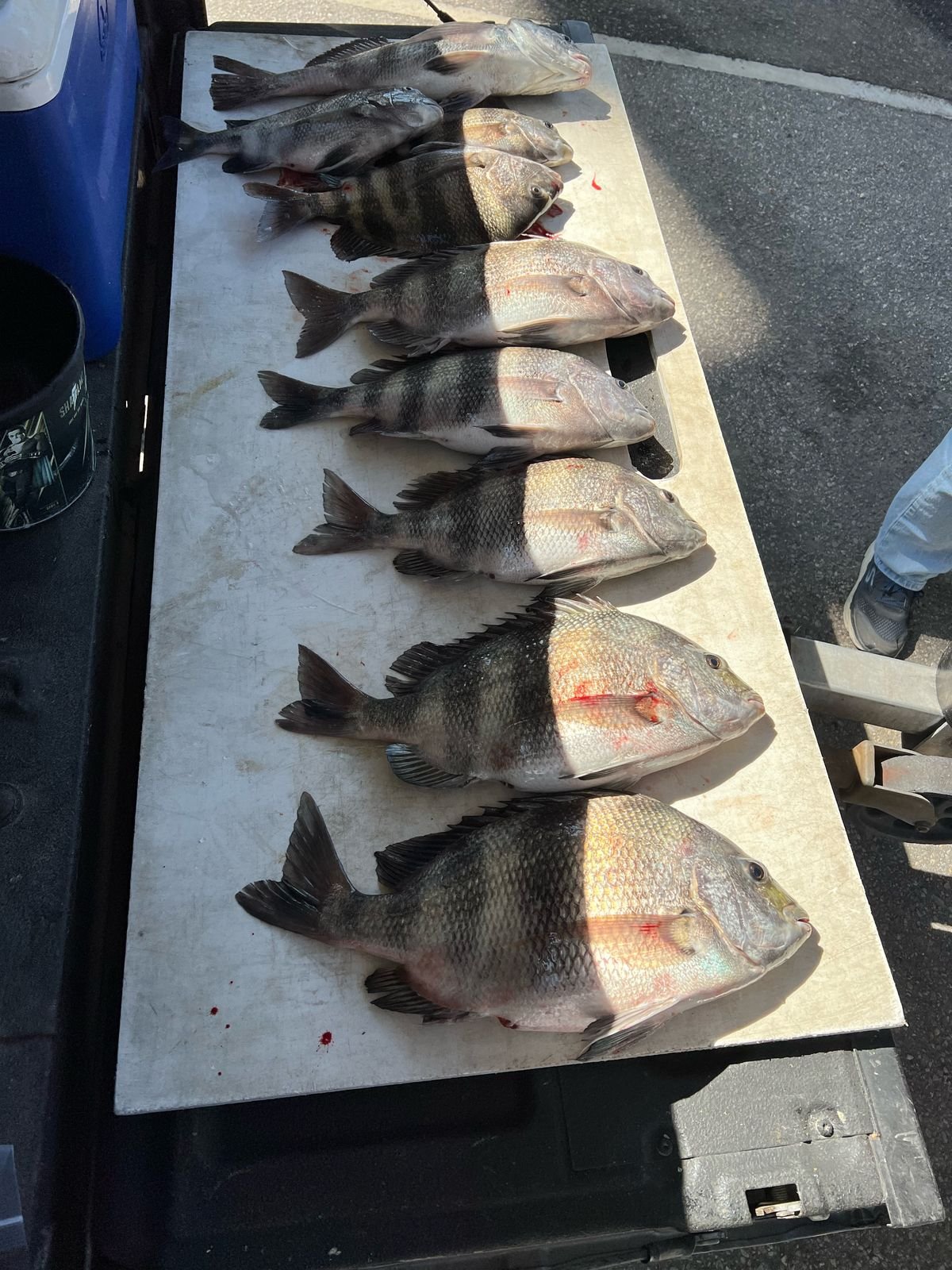
Sheepshead: the winter fish
When and why
Craig Newton, the artificial reef coordinator for the Alabama Marine Resources Division, explained the seasonal pattern in a 2023 Outdoor Alabama article (Outdoor Alabama, February 2023). Through summer, fall and early winter, sheepshead are spread across the estuaries in tidal creeks, on grass flats, around structure and in river channels. In January they start gathering around deep-water structure in the lower bays. In February they gather on nearshore structure, and most spawning happens from February through March. Because there isn’t much structure close to the coast, the fish can get very concentrated on the structure that is there.
Spawning fish need a lot of food, so they feed heavily and can be less picky. After the spawn, they spread out again and get harder to catch.
Where to look around Gulf Shores and Orange Beach
Sheepshead feed on barnacles and the small crabs and shrimp that live on hard, salty-water structure. In that article, state biologists named:
- The jetties at Perdido Pass in Orange Beach. Marine Resources Director Scott Bannon described boats packed so tight at the pass that “you could almost jump from boat to boat.”
- The Perdido Pass Bridge and the Dauphin Island Bridge.
- Inshore artificial reefs in Mobile Bay and Mississippi Sound. The state lists locations on its inshore reef zones page.
- Gas rigs in the lower bays and nearshore waters.
- Public piers. Bannon named the Fairhope Fishing Pier, Cedar Point Fishing Pier, Gulf State Park Pier and Fort Morgan Pier, plus jetties and rocky shorelines. That was in 2023, so check that any pier is open before you drive down.
Inside waters like the Gulf Intracoastal Waterway through Gulf Shores and Orange Beach have bridge pilings, bulkheads, docks and rocks. That’s the same kind of hard, barnacle-covered structure the biologists describe, which makes it worth checking. This is our inference from the habitat description, not a specific state recommendation. Be courteous around private docks and stay clear of barge and boat traffic in the waterway.
Bait and tackle
The state’s advice in that article is simple:
- Bait: Live shrimp or live fiddler crabs are the most common baits. Newton called fiddler crabs his favorite. Peeled fresh-dead shrimp also work. Call local bait shops before you go to see what they have.
- Line: Start with 10- or 12-pound test, depending on water clarity. If you keep getting cut off, move up to at least 15-pound test. Fluorocarbon handles abrasion better than monofilament.
- Hooks: Skip fine-wire hooks. A sheepshead’s teeth crush barnacles, so use strong hooks and a rod that can pull the fish away from the structure.
- Bring spares. You’ll lose sinkers, leaders and hooks on barnacle-covered rocks and pilings.
Sheepshead are famous bait thieves. The article’s rule of thumb: if you don’t get a bite within a couple of minutes on a promising spot, you’ve probably been robbed. Reel in and rebait. It takes practice and a light touch to feel the bite.
Which ones to keep
The legal minimum is 12 inches fork length, measured from the tip of the snout to the fork of the tail. But Newton and Bannon said a 15- to 16-inch fish is a better size to keep. Sheepshead have a big head and large ribs, so small ones don’t yield much meat. The Alabama state record is 16 pounds, 6 ounces, caught in March 2022 at the Gulf State Park canal weir on live shrimp, according to the same article.
A note on the limit: That 2023 article lists a 10-fish bag limit. The current state table, checked November 1, 2026, lists 8 per person. Use the current table.
Pompano: late winter into spring
Florida pompano are a surf fish, and most of the action is from the beach. Matt Isbell, a Gulf Shores surf-fishing guide interviewed by Outdoor Alabama in 2018, put it plainly: “March, April and May – those are the three months to catch pompano” (Outdoor Alabama, 2018). He also said pompano fishing tends to improve when the weather cools in the fall. In the coldest months he mostly targets whiting, which he said get bigger and more plentiful in winter, sometimes pushing 2 pounds.
So if you’re on the beach in December or January, plan on whiting and maybe a pompano. If you’re there in March, plan on pompano.
How to fish the surf
A 2026 guide by longtime coast outdoors writer David Rainer for the Gulf Shores and Orange Beach tourism site covers the basics (GulfShores.com):
- Where: The surf zone, where waves stir up the bottom and expose crustaceans. Boat anglers also find pompano around sandbars on a falling tide. Look for the clearest water you can find. Schools of 3 to 6 fish are typical, and sometimes they’re as far out as the second sandbar.
- Bait: Fresh sand fleas (mole crabs) or ghost shrimp, cast just past the breakers. You can dig sand fleas at the water’s edge. Peeled shrimp works too, and many anglers add a piece of scented artificial bait.
- Rig: A double-hook pompano rig with the lightest pyramid sinker the surf allows, ideally 1 ounce or less, but bring a range of weights. Hooks from size 8 to 1/0. A 10-foot rod with 15-pound line handles long casts. When fish are finicky, switch to light tackle with 8- to 10-pound line.
- Lures: A small pompano jig with a short, brightly colored bucktail skirt, hopped along the bottom back to the beach.
Fish away from swimmers. In winter that’s rarely a problem.
Pompano or permit?
Permit, a larger cousin of the pompano, have been turning up on the Alabama coast in recent years. According to Rainer’s article, small permit have orange patches on the chin, fins or belly where pompano have yellow. The pompano’s dorsal fin is short and upright, while the permit’s is long and swept back. The pompano limit is 3 per person with a 12-inch total-length minimum. The Alabama record pompano is 6 pounds, 13 ounces, caught in 2010. If you’re not sure what you’ve caught, check the current state rules before you keep it.
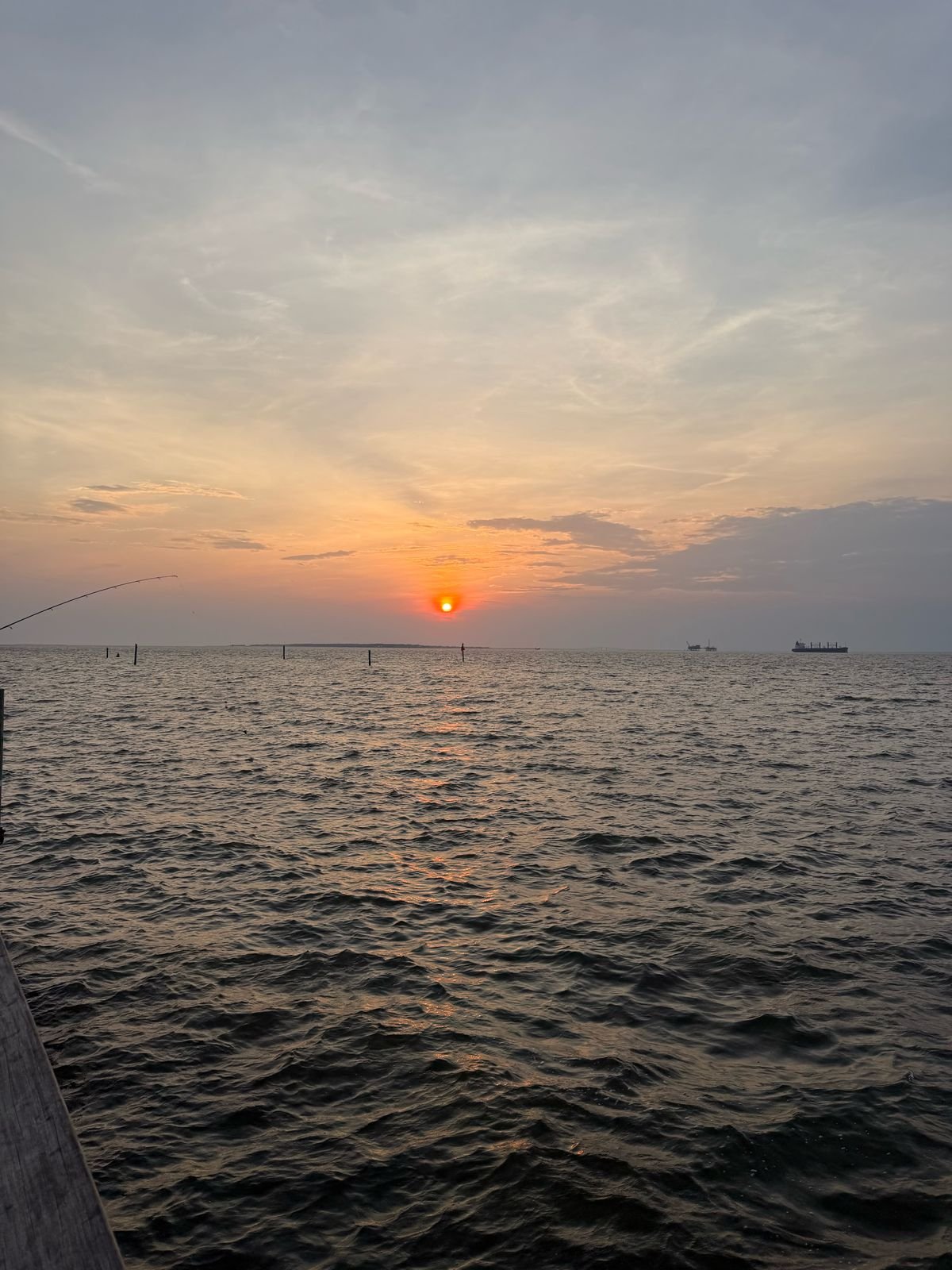
Gulf State Park Pier in winter
The Gulf State Park Fishing and Education Pier in Gulf Shores is the easiest no-boat option. The park lists sheepshead, red drum, Spanish mackerel, flounder, Florida pompano, king mackerel and whiting among the species caught from the pier, depending on the season. Here’s what we found on the park’s page on November 1, 2026:
- Open 24 hours, 7 days a week. From September 8 to March 1, staff are on site 6 a.m. to 5 p.m. Outside staffed hours, you pay at an honor box.
- All-day fishing: $10 for adults, $7 for veterans and campground or lodge guests, free for children 11 and under. Weekly, monthly, six-month and annual permits are $41, $81, $161 and $321.
- Parking is $15 a day for a car and includes one daily pier fishing permit.
- The pier fee doesn’t include a fishing license. You still need an Alabama saltwater or pier fishing license.
- One rod in the water per angler, and you can’t leave rods unattended. Rod and reel rentals are $10 for 4 hours.
- Pier office: (251) 967-FISH (3474).
Two state rules apply around the pier: no shark fishing from the Gulf State Park pier or public beach, and no fishing, boating, swimming or other water activity within 100 yards of the pier (Ala. Admin. Code 220-5-.02). If you’re fishing from a boat or the beach nearby, keep your distance.
Other winter options
- Whiting from the beach: A good winter target, according to Isbell. Small pieces of shrimp on a pompano rig work for both species.
- Black drum: Isbell mentioned occasional winter runs of big black drum in the surf.
- Redfish and speckled trout in the backwaters: Redfish must be 16 to 26 inches total length, 3 per person. Speckled trout must be 15 to 22 inches, 6 per person, and one of those may be over 22 inches.
- Flounder: Closed in November. Check the current table before targeting them in other months.
Before you go
- Buy your saltwater license. Resident seniors 65 and older don’t need one but must register in the Saltwater Angler Registry. Residents can fish from a licensed public pier on inside waters without a license. See our license guide for details.
- Check the wind and the surf. Winter cold fronts bring strong north winds and big swings in temperature. Look for protected water on windy days. State biologists noted that sheepshead fishing is a good choice partly because you can often find shelter and still catch fish.
- Dress for the cold, wet weather. Winter water on the Gulf is cold, so wear a life jacket on the boat.
- Recheck the limits. The state changes saltwater rules more often than freshwater ones, and the sheepshead limit has already dropped from 10 to 8.
If you’re heading down from the Tuscaloosa area, our weekly Dixie Fishing Report covers inland conditions. Our freshwater creel and size limits cheat sheet covers the rules once you’re back on the lakes.