
Most bass fishing coverage in Alabama goes to the big-name lakes. The Black Warrior River doesn’t get nearly as much attention. It runs right through Tuscaloosa, and its locks and dams create a string of tailwaters where moving water pulls bait and bass into predictable places. This guide covers how the river’s dams are laid out, what the state says lives below them, how to read generation and flow before you go, and the safety rules that matter more here than on any flatwater lake.
Quick facts
- The river: The Black Warrior runs about 178 miles. It forms where the Mulberry and Locust forks meet in Bankhead Lake and joins the Tombigbee at Demopolis (Outdoor Alabama, Black Warrior River).
- Dams, upstream to downstream: Bankhead Lock and Dam, Holt Lock and Dam, Oliver Lock and Dam at Tuscaloosa, and Armistead I. Selden Lock and Dam near Eutaw. Each tailwater is the upper end of the next pool down: Holt Lake, Oliver Lake, Warrior Lake and Demopolis Lake.
- Who runs what: The U.S. Army Corps of Engineers owns the locks and dams. Alabama Power owns and runs the hydro plants at Bankhead and Holt and posts their tentative generation schedules (Alabama Power Shorelines, Holt).
- Bass on hand: Largemouth and spotted bass. In the upper Mobile basin, which includes the Black Warrior, the fish most anglers call spotted bass are now classified as Alabama bass (Outdoor Alabama, black bass).
- Creel: Statewide black bass limit of 10 per day in aggregate, with no more than 5 smallmouth (creel and size limits). When we checked, the state’s list of reservoir-specific bass rules didn’t include the Black Warrior pools. Rules change, so check the page before you keep fish.
- Last checked: October 31, 2026.
Why the tailwaters hold bass
A tailwater is the stretch of river just below a dam. When water comes through turbines, spillway gates or a lock, it brings current, oxygen and disoriented baitfish. Bass don’t have to roam a big flat looking for food. They can hold behind a rock, a wall or a seam and wait for current to bring dinner to them.
The state’s own reservoir pages back this up. Outdoor Alabama describes the tailwater below Bankhead Dam, at the top of Holt Lake, as a popular area where anglers catch largemouth and spotted bass along with drum, catfish, buffalo and hybrid striped bass. It notes that spotted bass tend to be found in Holt’s riverine portions (Outdoor Alabama, Holt Reservoir). Its Warrior Reservoir page calls the Oliver tailrace a high-use area for hybrids, catfish, drum and crappie (Outdoor Alabama, Warrior Reservoir).
The tailwaters, one at a time
Below Bankhead (upper Holt Lake)
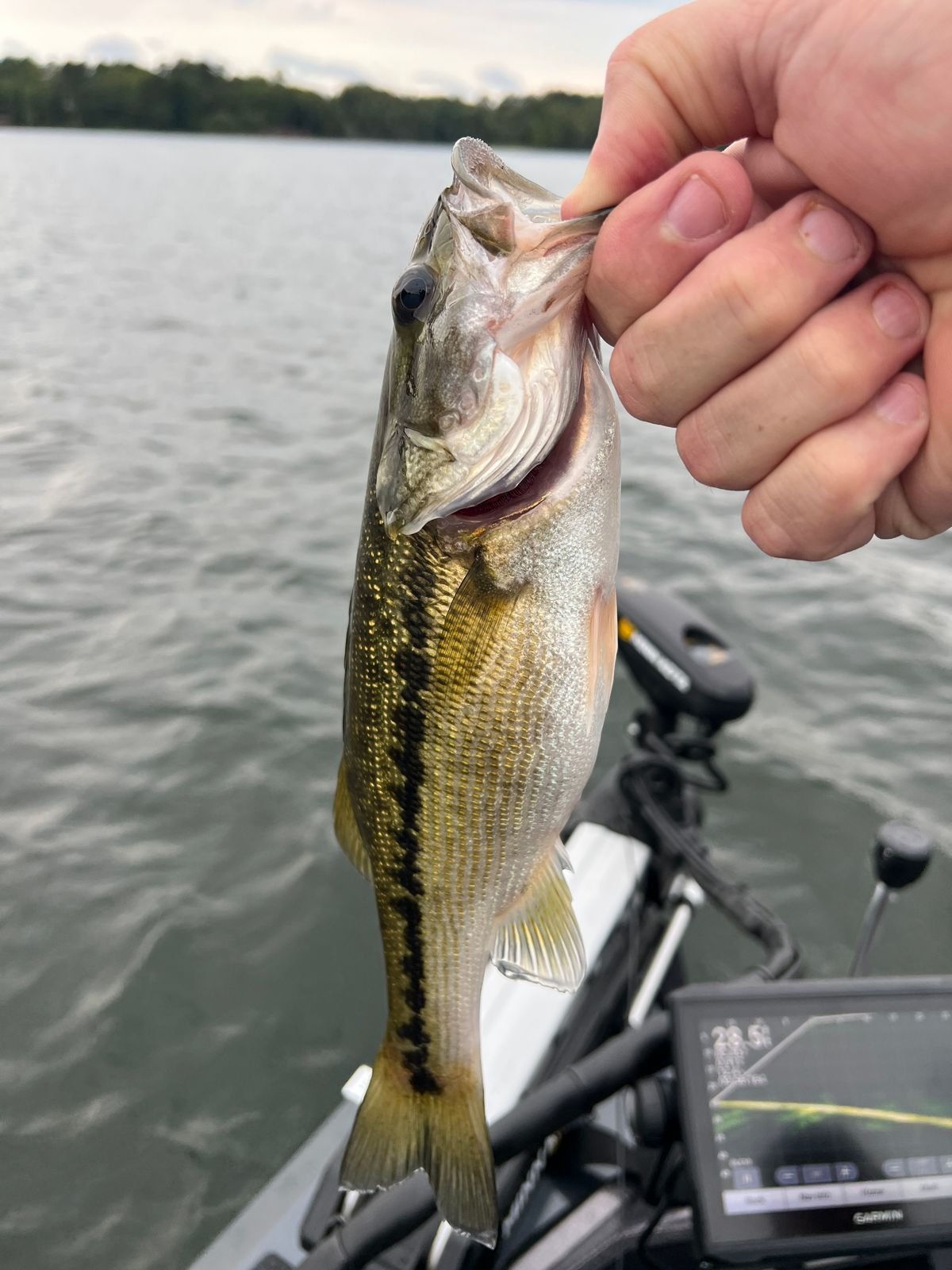
Holt Lake covers about 3,296 acres, according to Alabama Power and the state. Outdoor Alabama’s sampling notes describe largemouth up to about 18 inches and spotted bass up to about 15 inches. Those numbers come from older sampling, so treat them as a general picture, not a promise. The state also says a “boating lane” gives boat access to the area below Bankhead Dam. This is a good piece of river to learn first if you live in Tuscaloosa, Northport or western Jefferson County. For more on the lake itself, see our list of the best fishing lakes near Tuscaloosa.
Below Holt (upper Oliver Lake)
Oliver Lake is the short pool through Tuscaloosa. The Corps describes it as about 9 miles long and about 1,000 acres, with launches managed by the Tuscaloosa County Park and Recreation Authority. Water released from Holt moves through a narrower, more river-like channel here, so current breaks are easy to spot when the plant is running.
Below Oliver (upper Warrior Lake)
The City of Tuscaloosa says Oliver Lock and Dam has picnic areas, restrooms, a playground and parking, and it’s the western trailhead of the city’s Western Riverwalk (City of Tuscaloosa). The Corps closed the Oliver Fishing Pier Park in 2023 for renovation. We couldn’t confirm the pier’s current status, so check before you plan a bank trip around it. Below the dam, Warrior Lake stretches about 76 river miles to Selden Lock and Dam (Corps of Engineers, Selden data).
Below Selden (upper Demopolis Lake)
Outdoor Alabama says hybrids of 3 to 8 pounds are caught below Oliver Dam and in the tailrace below Selden (the state’s page calls it Warrior Dam). This stretch is farther from town, but it follows the same rules. When water is moving, bass and bait gather on current breaks.
Read the water before you launch
On a tailwater, the release schedule matters as much as the weather. No current can mean scattered fish. Steady current usually positions them. A sudden surge can be dangerous.
- Bankhead and Holt: Alabama Power posts lake levels and tentative generation schedules on its Bankhead and Holt pages. On October 31, 2026, Bankhead showed no generation scheduled through November 2. Holt showed one unit from 8 to 9 p.m. on November 1 and 2. The company calls these schedules tentative.
- Oliver and Selden: The Corps’ Mobile District posts pool and tailwater elevations and flows for Oliver and the other Black Warrior projects.
- River flow: The USGS gauge on the Black Warrior River at Northport read about 379 cubic feet per second late on October 31. USGS daily statistics for that date put the median at about 835 cfs and the 25th percentile at about 397 cfs. In other words, the river was running low for the date, which fits the drought in the area. When flows are this low, the short generation windows are often the only time there’s real current.
A practical habit is to plan your trip around the scheduled release and arrive early. Watch how the water changes when the units start. Fish that sat tight to cover in slack water often slide out to the edges of the current once it starts moving. Our guide to how to read lake level and dam generation schedules walks through the Alabama Power and Corps data pages in more detail.
Where bass set up in current
Every dam is different, and the restricted areas just below each one are off-limits (more on that below). Outside those areas, these are the kinds of spots worth fishing:
- Current seams: The line where fast water meets slow water. Bass often hold on the slow side and dart out to feed.
- Eddies behind structure: Points, rock piles, bridge pilings and the downstream ends of walls create slack pockets next to the current.
- Riprap banks: Rock along the banks below dams draws crawfish and baitfish. Work it parallel to the bank where you can do so legally.
- Creek mouths and sandbars downstream: As you move away from the dam, look for the first breaks where current softens.
- Bluff and channel bends: On the outside bends, current pushes bait against the bank. On the inside bends, slower water gives fish a place to rest.
What to throw
These are common tailwater choices, not a secret recipe. Match your bait to the current speed and the forage, which is mostly shad, herring and crawfish.
- Swimbaits and grubs on a jighead: Cast up-current and let them swing through the seam. White and shad colors are hard to beat when bait is getting pulled through the dam.
- Crankbaits: Medium-diving baits along riprap and across rocky points when the water is moving.
- Jigs and Texas-rigged soft plastics: For eddies and rock when the current is weak, or when bass are holding tight to cover.
- Shaky heads and drop shots: A finesse option for spotted bass in clearer water or after a cold front.
- Topwater: On calm, warm mornings, schooling fish can blow up on shad at the surface. Keep one rigged.
Use enough weight to reach the bottom in current, but no more than you need. In heavier flow, a heavier jighead or bullet weight keeps your bait in the strike zone. In slack water, scale down.
Safety below the dams
Tailwaters are some of the most productive water on the river and some of the most dangerous. Take this part seriously.
- Stay out of restricted areas. Signs and buoys mark the zones below each dam. Don’t go past them, even if other boats do.
- Expect sudden changes. Alabama Power’s Holt page lists hazards below the dam that include turbulent discharges from automatically operated turbines, strong upstream currents at the surface (reverse flow), swift water below spillway gates and rapidly rising water.
- Don’t anchor in the tailrace. The Corps warns on its Walter F. George fishing page that generators can start without warning and that boats anchored below dams can be overturned. That warning applies to any dam with turbines.
- Give barges a wide berth. The Black Warrior is a working commercial waterway. Tows need room to maneuver, and they can’t stop quickly. Never fish in the lock approach.
- Wear your life jacket. This matters even more from the bank, where riprap can be slick and unstable.
Rules and etiquette
- Licenses: Residents 16 to 64 and nonresidents 16 and older need an Alabama fishing license. See our Alabama fishing license guide.
- Don’t move fish: In Alabama, it is illegal to move a bass or other aquatic organism from one public water to another without a permit (Outdoor Alabama).
- Upstream walleye rule: Walleye can’t be kept from the Mulberry Fork and Sipsey Fork and their tributaries. That matters if you fish the upper river above Bankhead.
- Share the spot: Good tailwater seams are limited. Don’t crowd another boat or cut across someone’s drift.
- Statewide limits and lake exceptions are on our Alabama freshwater creel and size limits cheat sheet.
A river worth learning
The Black Warrior has more history than its reputation suggests. The state record blue catfish, 120 pounds 4 ounces, came from Holt Reservoir in 2012. The world-record landlocked striped bass, 69 pounds 9 ounces, came from Bankhead in 2013 (Outdoor Alabama, state records). Bass are the everyday draw, though. Check the schedule, fish the current and stay well clear of the dam.
If you’d rather fish a clear, deep lake near town, see our Lake Tuscaloosa fishing guide. If you want to fish the lake above the Black Warrior system, see our guide to winter spotted bass on Smith Lake. For this week’s conditions across the area, see the Dixie Fishing Report for the week of Nov. 2.
Pingback: How to Read Lake Level and Dam Generation Schedules for Better Fishing – Dixie Fishing